

Most network scientists arrive at the field through physics, mathematics, or computer science, Justin Wang Ngai Yeung found his way through archeology and a paper on ancient Caribbean socio-material networks.
"Archaeology actually drew me to network science," explains Justin, a second-year PhD student at NetSI London. During his undergraduate studies in the Netherlands, a course on applying network science to humanities domains such as archaeology changed everything. Learning that he could apply statistical and experimental network approaches to an apparently unrelated field like archeology opened Justin’s eyes to the limitless potential of networks. What further contributed to this realization was his professor’s work analyzing behaviors among Caribbean countries in sourcing raw materials, which revealed how socio-material networks can unveil historical relationships. "This was something I would have never thought of doing using networks," Justin recalls. "It was so detached from the typical questions that you can ask with a purely physics or mathematical background, and I thought, this is super cool, network science is going to be my life mission."
That mission has taken Justin on a remarkably productive journey. After completing his master's in Data Science at Oxford Internet Institute, he joined the Network Science Institute in London under the supervision of Prof. Riccardo Di Clemente. In 2025 alone, he has co-authored three papers, appeared on the Data Skeptic podcast, earned two prestigious fellowships, and was featured alongside prof. Di Clemente in Northeastern Global News.
When data goes missing: criminal networks and the problem of incompleteness
One of Justin's works this year tackles a challenge that would make any data scientist uncomfortable: what happens when you're trying to estimate links in a network, but 85% of your data is missing? His paper "Garbage in garbage out? Impacts of data quality on criminal network intervention" examines one of the most extreme examples of data incompleteness: the criminal networks, asking how the inaccuracy and lack of data impact the work of law enforcement agencies in effectively disrupting criminal networks, where data incompleteness isn't just a technical problem, it's the nature of the beast.
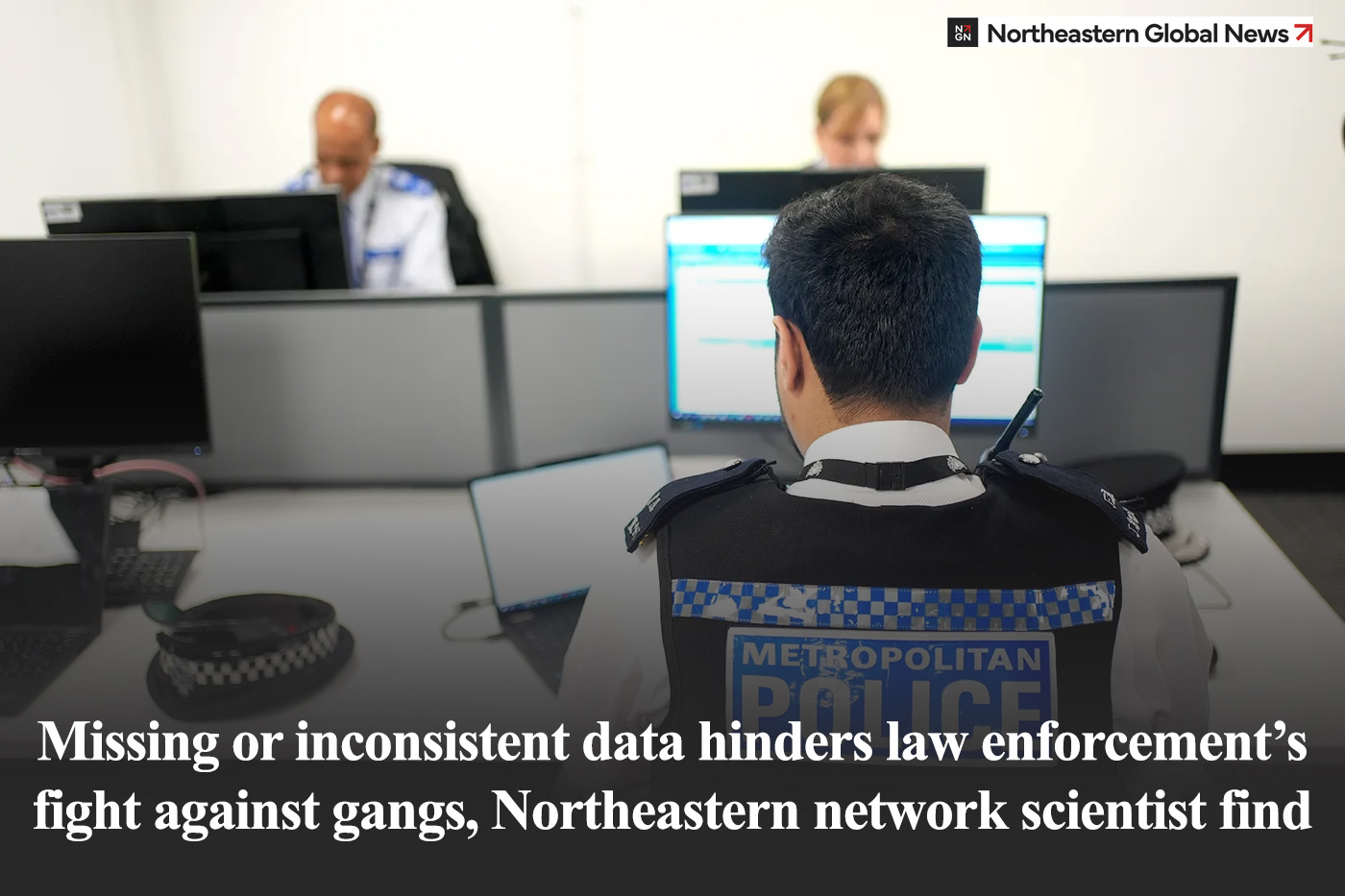
"Criminal networks are infamously difficult to study," Justin explains. "people in these networks are smart at hiding and manipulating their own data, and most of what we know comes from post-hoc investigations: arrests, court records. You only have data about what already happened, but you're missing everything else." Using percolation theory, Justin and his co-authors tested the resilience of criminal networks by simulating the removal of nodes and links, essentially modeling what happens when law enforcement arrests key individuals.
Their findings challenge conventional assumptions. Even with bad data, having some information is better than none. Yet the reality is stark: having no data remains a really big problem, aligning with findings of other studies, only missing as little as 20% of the data can be troublesome. While in a lot of cases we really only know about 15% of criminal network activity accurately.
But Justin's research isn't just about numbers. His podcast appearance and paper emphasize humility in academic-practitioner relationships. "You can't just go to law enforcement with fancy mathematical frameworks," he insists. "Most practitioners wouldn’t understand them and they don’t have the data, which is fine. We need to help them model uncertainty, not sell them perfect solutions." He also raises crucial ethical questions: perfect data collection would require total surveillance, essentially assuming everyone is a criminal.
Building bridges through fellowships and public engagement
Justin's commitment to crossing disciplinary boundaries extends beyond his research. As a Public Tech Media Research Fellow at UW Madison, he organizes the Critical Platform Studies working group, hosting monthly seminars that bring together scholars, activists, and industry representatives to discuss how we can study small and big platforms more critically, ethically, and responsibly. "Network scientists can sometimes be overly self-confident, we think we have the right answers but we don't necessarily," he admits. "We need to be open-minded and ask for help."
His visiting fellowship at Nokia Bell Labs, to which he was introduced by Prof. Di Clemente, adds another dimension, where he's building AI systems to explain urban venue popularity across cities like London, Barcelona, and New York. The project compares how standard LLMs, specialized agentic systems, and human-AI collaboration differ in providing business insights, a practical application that bridges computer science and urban studies with market research.
Advice to future network science PhD students
For prospective PhD students, Justin’s advice is refreshingly candid. “We have a responsibility to step outside the ivory tower. Translating nodes, edges, and abstract concepts into accessible language is a skill, so if an opportunity to talk about science presents itself, take it. No matter where your career leads, that ability to communicate clearly will always matter.” Also, “It’s totally fine that you don’t know what you want.” Justin encourages openness and curiosity. “Read widely”, he says, because “much has been tried before.” At the same time, be “fairly stubborn” about pursuing what genuinely interests you. “Don’t chase hype for its own sake. If you go into AI, do it for substantive reasons, not just trend-following.”
After all, if archaeology can lead to criminal networks via network science, who knows where your curiosity might take you?


