
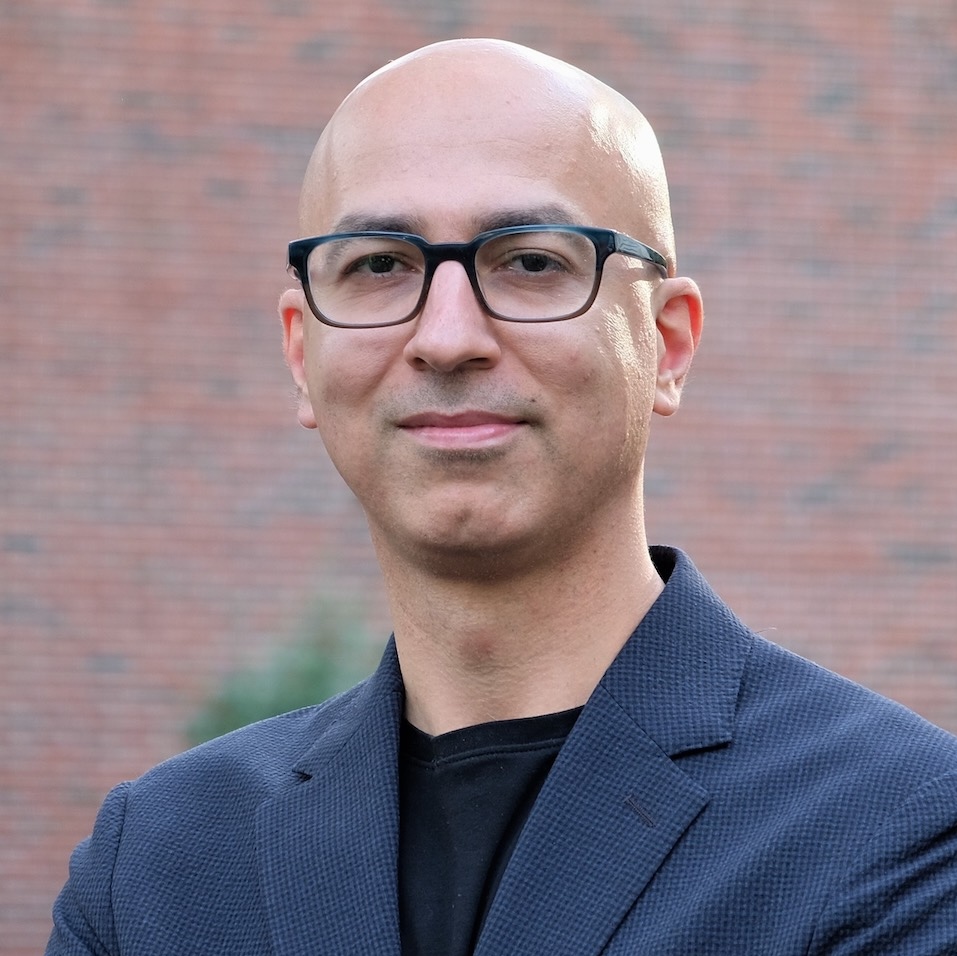
Babak Heydari, Professor of Mechanical and Industrial Engineering in Northeastern's College of Engineering and director of the MAGICS Lab (Multi-Agent Intelligent Complex Systems), has joined the Network Science Institute as core faculty. The move has been years in the making, growing out of the cross-disciplinary nature of his research. His sabbatical year at the institute only confirmed that NetSI would be the right intellectual home for him and his lab.
"A large part of my research has focused on how local behavior, the architecture of interactions, and emergent structural and behavioral patterns co-evolve," Prof. Heydari says. He has applied that perspective to multi-sided engineering platforms, product architectures that balance innovation and competition in consumer markets, the emergence of collective risk attitudes in epidemic modeling, and, more recently, human-AI systems. "The link between local interactions and collective behavior is at the heart of network science."
Pursuing that line of research has meant working across many fields at once, engineering systems design, economics, computational social science, and AI and machine learning. That breadth, Prof. Heydari says, is what makes NetSI "an ideal home" for his work. The institute connects him with colleagues who share a complex-systems perspective but come from the social and political sciences, health sciences, computer science, and the mathematical modeling of network dynamics. "These interactions help me frame AI questions at the system level rather than the model level, which is where I think many of the most important questions about AI now lie," he says.
The architecture of interaction
That system-level framing now drives a broader shift in Prof. Heydari's research. He is reorienting much of his work on multi-agent sociotechnical systems toward human-AI systems, studying complementarity, trust, and alignment as properties of the whole system rather than of individual models.
A recurring idea in his lab's work is governance through architecture, or how collective outcomes can be shaped not by changing the agents in a system, or even only their incentives, but by redesigning the architecture through which they interact. In a recent preprint, presented at the NSF AI-SDM Workshop at Carnegie Mellon University, he applies this idea to human-AI teams. He argues that complementarity may be something the interaction architecture can "create, amplify, or destroy," and that because humans learn and AI systems change, "an architecture that works well today may not be the right architecture tomorrow."
Can AI stand in for people?
Studying human-AI systems at this scale also raises a more basic question: when AI agents interact, do they behave the way people would? A new paper with PhD student Hongan Zhu, forthcoming in Nature Computational Science, tackles this question as it applies to a growing practice in the social and behavioral sciences, using large language models as stand-ins for human participants. An AI agent can give answers that sound human without actually reasoning the way people do, and that gap matters most when many agents interact and small choices compound into collective outcomes.
To test this, the team used the Beer Distribution Game, a classic supply-chain simulation developed at MIT in which players manage orders along a chain from retailer to factory. Human players famously over- and under-order, turning small changes in customer demand into large swings up the chain. Across 231 sessions, AI agents reproduced this instability but got its size and timing wrong. Giving the agents a plain description of how people tend to reason in such situations, an approach the authors call cognitive grounding, brought all seven models tested closer to real human behavior. The results suggest grounded AI agents could serve as credible stand-ins for people in studies of collective behavior, provided they are validated for each task.
For Prof. Heydari, joining NetSI closes a loop, a researcher who studies how the structure of interactions shapes collective behavior has found, in the institute's network of disciplines, the structure that best supports his own work.


