
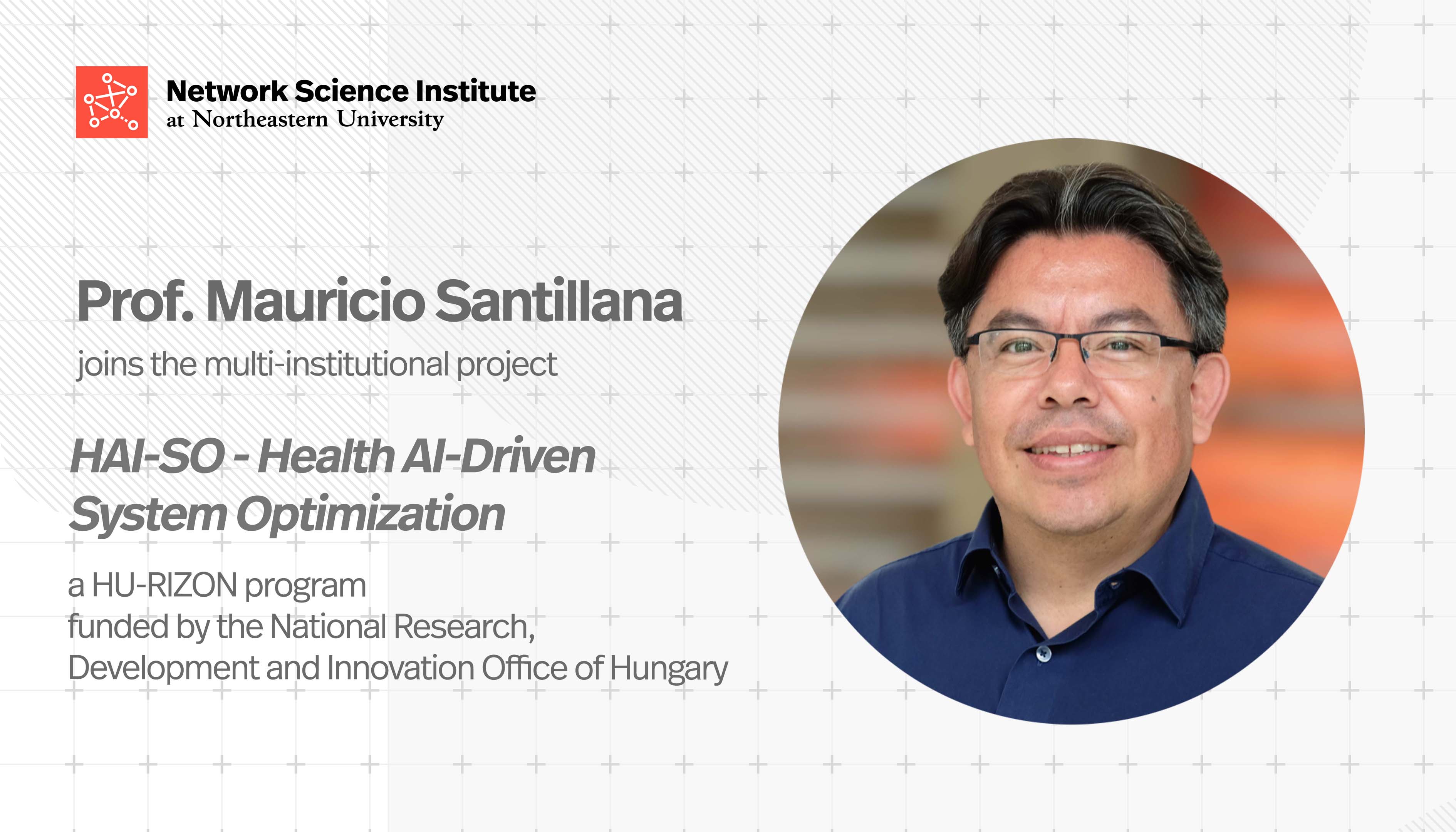
The Network Science Institute is delighted to announce that Prof. Mauricio Santillana and his Machine Intelligence Group for the betterment of Health and the Environment (MIGHTE) are partners in a newly funded international project, “HAI-SO: Health AI-Driven System Optimization,” supported by Hungary’s HU-RIZON International Research Excellence Cooperation Programme.
The two-year project, funded with [amount], brings together five institutions from Hungary, the United States, and Czechia. Together with Harvard Kennedy School’s PIAS-Lab, the MIGHTE Lab at the Network Science Institute (NetSI) will co-lead the project’s AI research and application development work package. Prof. Santillana is Professor of Physics and Electrical and Computer Engineering at Northeastern, core faculty at NetSI, and Adjunct Professor of Epidemiology at the Harvard T.H. Chan School of Public Health.
About the project
Most AI tools in healthcare are built for a single clinical task. HAI-SO aims to address how can AI and large-scale data be used to improve how whole health systems and hospitals operate? This includes resource allocation, patient pathways, decision-making, and outcomes.
The project builds on one of Europe’s most comprehensive national health data ecosystems. This includes Hungary’s national eHealth platform (EESZT), longitudinal claims data from the National Health Insurance Fund (NEAK), and hospital information systems. Research will focus on use cases selected from four thematic areas:
- Intensive care units: predicting deterioration, length of stay, readmission, and mortality, and optimizing admission and discharge.
- Pharmaceutical use: demand forecasting, flagging drug interactions and adherence risks, and national monitoring of prescribing and spending.
- Non-communicable disease pathways: detecting guideline deviations and regional gaps in diabetes and lung cancer care, and simulating optimized pathways.
- Emergency departments: triage support, early-warning alerts, and forecasting patient volumes from historical and environmental data.
MIGHTE Lab will contribute methods in time-series forecasting, network analysis, and early-warning AI systems. It will also mentor Hungarian doctoral and early-career researchers. The tools the team develops will be piloted within Hungary’s national eHealth infrastructure and in parallel in Czechia, followed by a comparative evaluation and policy recommendations for scale-up.
The team
- Semmelweis University, Health Services Management Training Centre (Hungary): Lead Partner, led by Prof. Miklós Szócska (Principal Investigator)
- Northeastern University, MIGHTE Lab (USA): led by Prof. Mauricio Santillana
- Harvard Kennedy School, Public Impact Analytics Science Lab (PIAS-Lab) (USA): led by Prof. Soroush Saghafian
- ESZFK, eHealth Service and Development Center (Hungary): operator of Hungary’s national eHealth infrastructure and lead of the pilot implementation work
- Prague University of Economics and Business (Czechia): led by Dr. Peter Pažitný
About HU-RIZON
HU-RIZON is run by Hungary’s National Research, Development and Innovation Office. It funds international research projects led by leading Hungarian research groups, with top universities and research institutes worldwide as partners. The projects address societal and economic challenges in the focus areas of digital transformation, healthy living, and the green transition and circular economy. The 2025 call had a budget of HUF 8 billion, with Hungarian universities leading consortia of 3 to 4 foreign partner universities.
This project is funded by the HU-rizon Programme of Hungary’s National Research, Development and Innovation Office (NRDI Fund).


