
The 2026 FIFA World Cup arrived in North America this June and quickly became the biggest and most watched sporting event in history, surpassing even the Olympics. With an expanded 48-team format, hosted across 16 cities in the U.S., Canada, and Mexico, the 2026 World Cup is the largest in the competition’s 96-year history. But while for most observers, the event is about goals, strategy, and wins, for researchers at the Network Science Institute, it is a massive real-time experiment in how networks behave under pressure. On the pitch, 22 players form passing networks whose structure predicts success or failure. In host cities, millions of travelers form a mobility and social network whose dynamics lead to heightened risks of imported diseases.
Two research groups at NetSI have been working in parallel, their subjects —players and fans—separated by scale, but their methods grounded in the same principles of complex systems science.
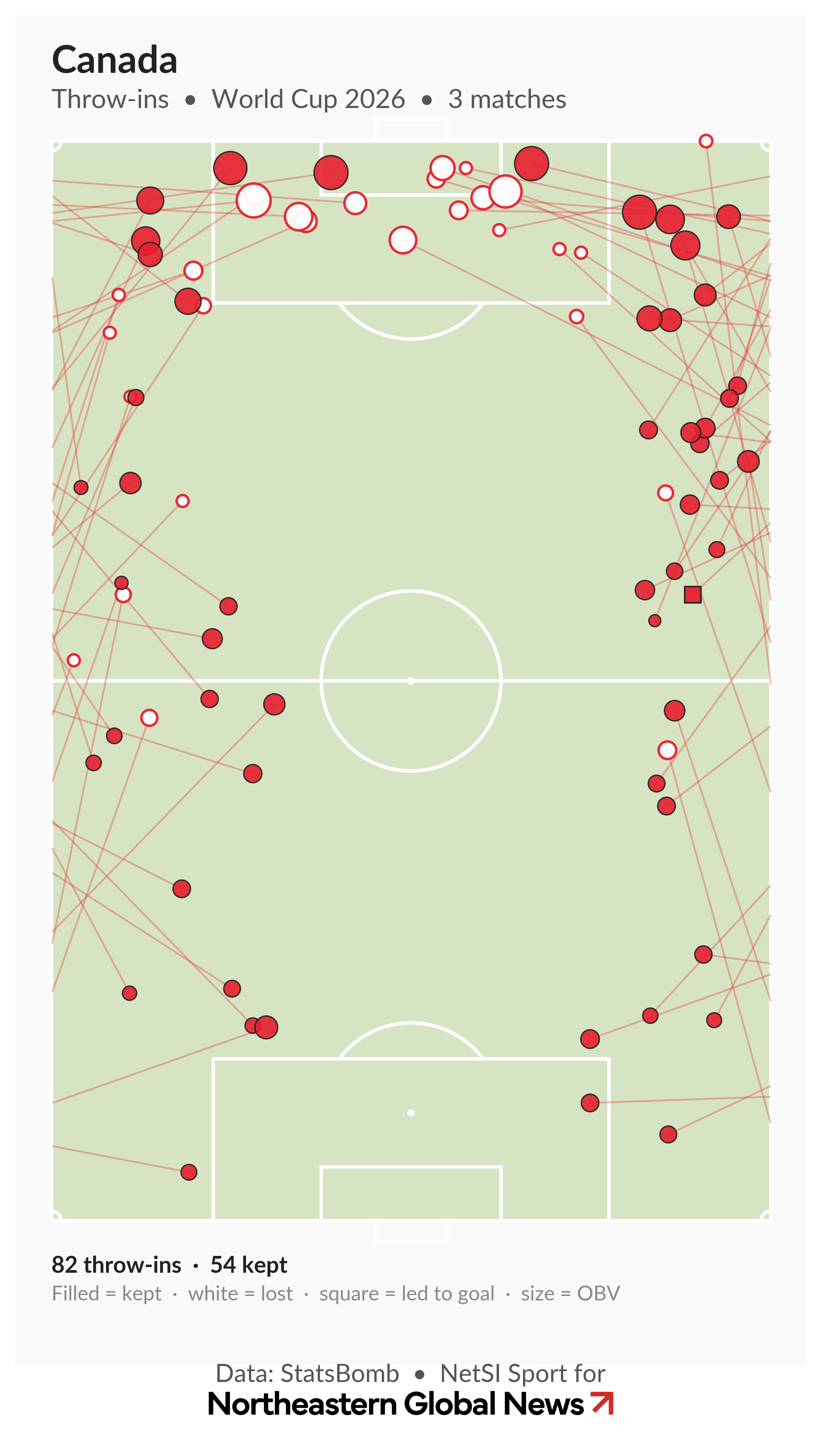
NetSI Sport, directed by Brennan Klein, looks at the game itself as a network rather than just a sequence of events. In the lead-up to the 2026 World Cup, the group mapped thousands of matches from the past five years, identifying emergent patterns, from individual player performance to how teams have evolved across tournaments, and revealing stylistic "signatures" that conventional statistics miss. When the tournament kicked off, these methods were applied to the World Cup itself, powered by the Statsbomb dataset and published through NGN Offside — a collaboration with Northeastern Global News — the NetSI Sport delivered detailed, data-driven portraits of the competing teams. Each team's distinctive style became legible once it was modeled as a graph of relationships. Co-presented with Northeastern women's soccer head coach Ashley Phillips, the work is a great example of what a research institute, University Athletics, and a media organization can produce together.
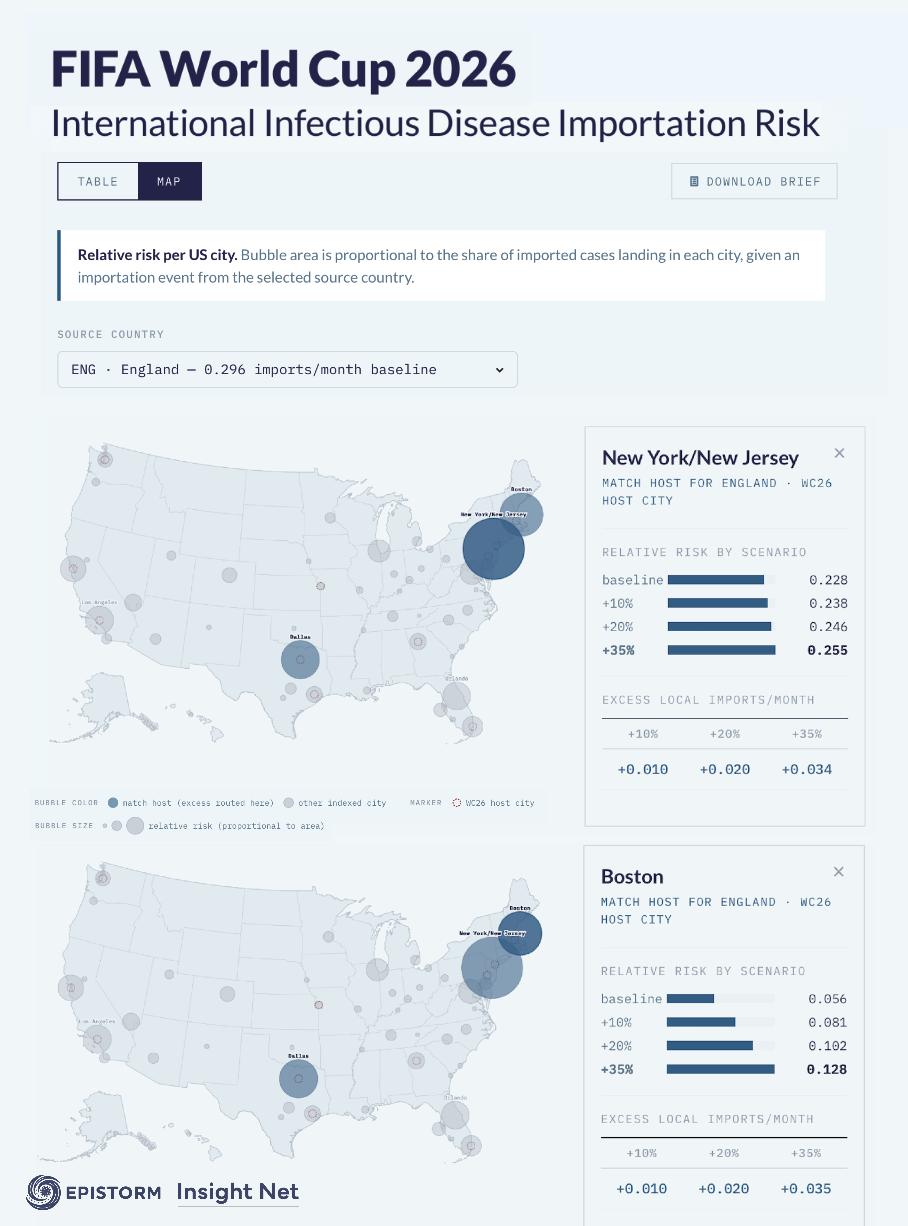
Across the institute, the MOBS Lab led by Alessandro Vespignani, whose team’s disease forecasting is already tracking the ongoing Ebola outbreak in the Democratic Republic of the Congo, has turned its attention to what up to 1.5 million additional World Cup visitors mean for public health. The core question is not whether the tournament creates risk in absolute terms, but whether it creates excess risk relative to the existing baseline of international travel. Working with NetSI researchers Prof. Jessica Davis, Alessandra Urbinati, and UNC epidemiologist Prof. Justin Lessler, in collaboration with the CDC's Insight Net, the team built a publicly accessible, live-updating dashboard that quantifies importation risk for 12 pathogens across all U.S. host cities. Developed through Epistorm and drawing on the GLEAM mobility framework and OAG airline data, the goal of this tool in Prof. Vespignani's words, is "situational awareness", not alarm, but intelligence. The framework, covered by Science Magazine, is already being extended toward the 2028 Los Angeles Olympics.
FIFA World Cup 2026 | International Infectious Disease Importation Risk dashboard


