

This August, the Network Science Institute (NetSI) at Northeastern University officially opened its newest research hub on Northeastern's Charlotte campus in North Carolina, expanding NetSI's footprint beyond Boston, London, and Portland, Maine, into one of the country's fastest-growing destinations for life sciences and medical innovation. As artificial intelligence becomes an integral part of how we collect health data, screen and diagnose disease, develop drugs, and manage entire healthcare systems, network science can help us understand the complex system that AI itself has become, so we can deploy it in ways that are beneficial for its users, be it healthcare practitioners, patients, researchers, or public health officials.
To answer why Charlotte and why now, NetSI Director Alessandro Vespignani framed the expansion as a response to the scale of today's scientific challenges. "The big challenges that we are facing scientifically now are not local problems," he said in a recent interview with Northeastern Global News, pointing to population displacement, climate change, pandemics, and the impact of artificial intelligence as problems that demand researchers working across places. Charlotte therefore becomes NetSI's newest hub in a distributed strategy, building on a strong regional healthcare and life sciences sector and on the local partnerships Northeastern has cultivated since opening its North Carolina campus 15 years ago.

The timing of NetSI Charlotte is also closely tied to the role digital technologies, and AI in particular, now play in public health and medicine. Research and practice increasingly depend on data science, machine learning, and AI to address pressing public health issues and to deliver advanced care to local communities. Northeastern has recognized this shift by introducing a Public Health Technologies concentration in the Master of Public Health program at both its Charlotte and Boston campuses. NetSI Charlotte brings to this shift a network science approach, plus the graph machine learning and optimization tools that come with it, treating health systems, disease spread, and human-AI interactions as the interconnected, complex systems network science is built to study.
The Institute’s work in North Carolina doesn't start from zero. Through Epistorm—the Center for Advanced Epidemic Analytics and Predictive Modeling Technology led by Northeastern University and part of CDC’s Center for Forecasting and Outbreak Analytics Insight Net, one of the largest funding efforts in public health technology to date —NetSI has been collaborating with UNC Chapel Hill, which is itself an Insight Net Center of Innovation—ACCIDDA. The collaboration goes back to 2020, and focuses on scenario modeling of respiratory pathogens including COVID-19, influenza, and RSV, where independent teams project the same set of "what if" scenarios — built on assumptions about vaccination, waning immunity, or new variants — and combine them into an ensemble that gives decision makers a longer horizon than short-term forecasts can offer.
NetSI has also been laying the foundations of a collaboration with Wake Forest University School of Medicine, building ties with researchers around forecasting, epidemic control, and antimicrobial resistance. The School of Medicine is the academic core of Advocate Health, the country's third-largest nonprofit academic health system, spanning 67 hospitals across six states and caring for nearly six million people a year.
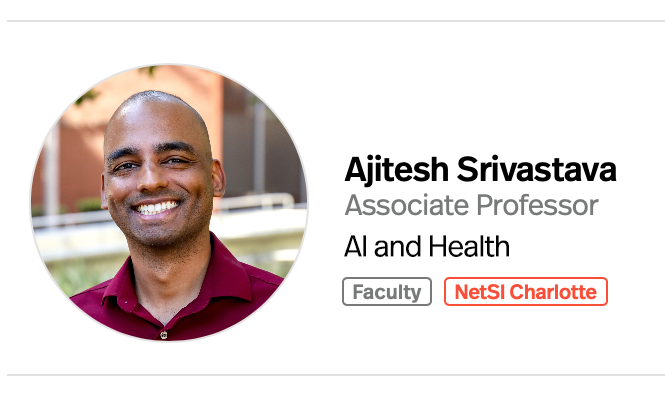
To anchor the new hub and its research direction at the intersection of public health, AI and network science, NetSI Charlotte has hired Ajitesh Srivastava as Associate Professor of AI and Health with a joint appointment across the Bouvé College of Health Sciences and the Khoury College of Computer Sciences. With his lead NetSI Charlotte will continue to pioneer research in graph machine learning and optimization to address challenges in complex systems, translate advanced techniques into practical, scalable tools for real-world public health applications, and provide actionable insights and predictions to help policymakers and community partners design, refine, and deploy targeted interventions.
Adding Charlotte to the hub network lets NetSI leverage not only each hub's unique strengths but also the similarities between them that can expand research possibilities. NetSI's Roux Institute hub in Portland, Maine, is a natural collaborator for NetSI Charlotte in this respect. Both campuses have built strong ties to their local hospital systems, and both North Carolina and Maine carry sizable rural populations facing a common set of public health pressures — opioid addiction, poverty, long distances to care centers, and the practical difficulty of collecting consistent health data across sparsely populated areas. That overlap gives NetSI a chance to test tools and models built in one state against a genuinely different, but structurally similar, population in the other.


