
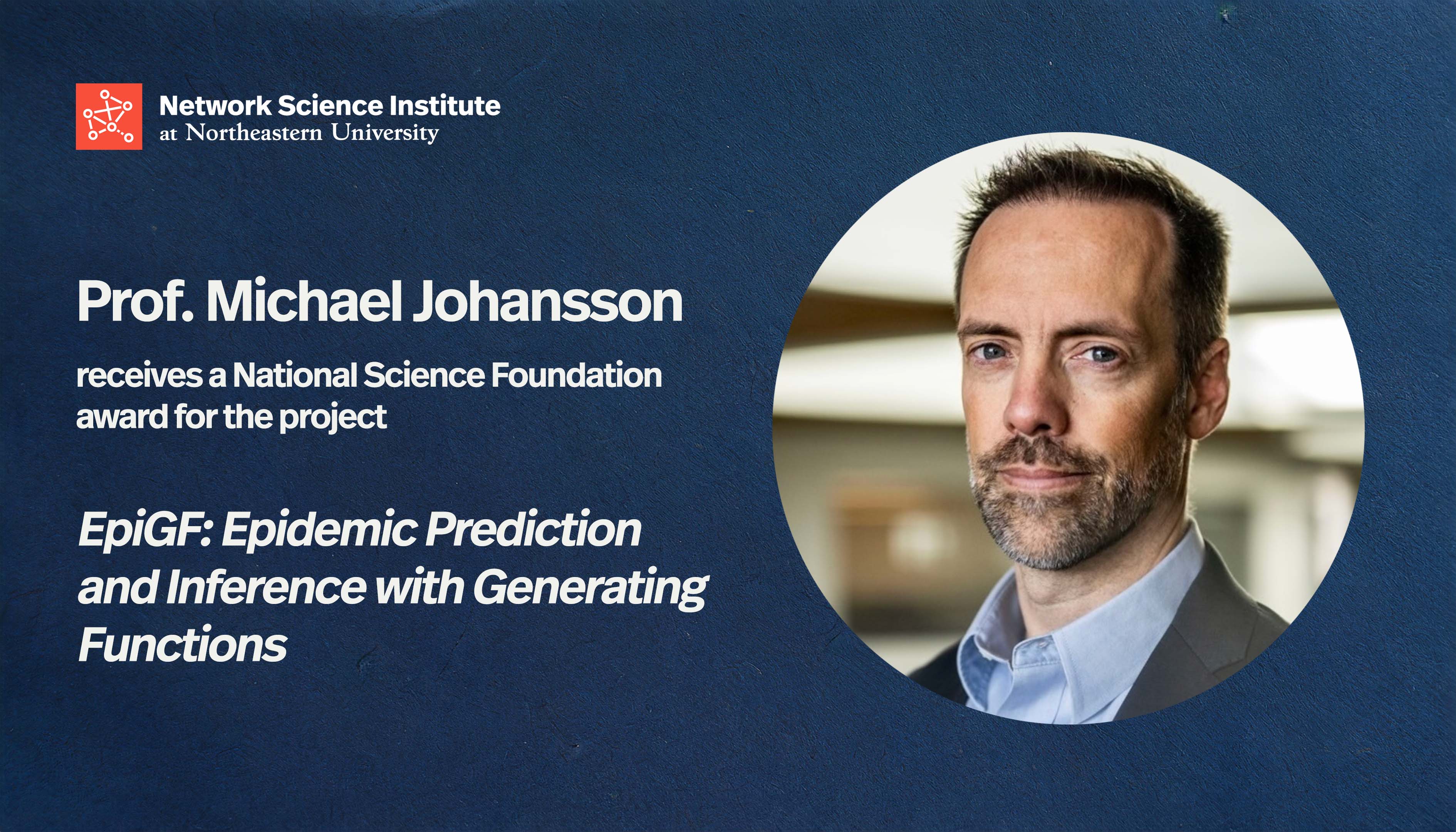
The Network Science Institute is delighted to announce that Prof. Michael Johansson has been awarded a grant from the National Science Foundation (NSF) for the project "EpiGF: Epidemic Prediction and Inference with Generating Functions." (Award #2619828)
The award of $250,000 will fund a research effort led by Prof. Mike Johansson (Principal Investigator) alongside Prof. Guillaume St-Onge (Co-Investigator). Prof. St-Onge, formerly a NetSI core faculty member, is now an Assistant Professor at the University of Ottawa and remains an affiliate of the Network Science Institute.
About the project
Epidemics are a persistent threat to human health, yet epidemiological data are always limited and generally delayed, which hinders prevention and control. Better real-time epidemic information and short-term forecasts would strengthen our ability to limit their impact. One key limitation of most current approaches is that they capture either the biology of transmission or the statistical trends in the data, but rarely both. Compartmental models, which are widely used, are a valuable tool for assessing spread potential, projecting impacts, and identifying drivers. However, they are challenging to fit to real-time data, which creates a tradeoff between mechanistic model complexity and efficient inference.
EpiGF sets out to overcome this tradeoff by modeling transmission as a branching process using probability generating functions (PGFs), linking the biology of transmission directly to reported epidemiological data. In a pilot project, the team showed that this approach can produce quality real-time forecasts of influenza hospitalizations. Building on that work, the EpiGF framework will:
- Combine mechanistic detail with efficient inference, allowing detailed infection processes to be fitted to varied, noisy, and complex epidemiological observations.
- Integrate multiple data streams, such as cases and wastewater testing data, together with mobility data, to strengthen inference.
- Link transmission across jurisdictions, providing a framework for spatiotemporal epidemic analytics.
- Estimate the time-varying reproduction number through robust inference.
- Forecast changes in incidence, jointly estimating uncertainty in trajectories and observations, and inferring acquired immunity from the underlying infection dynamics.
- Advance PGF-based inference more broadly, making PGFs more accessible for other systems modeled by multitype branching processes.
The methods will be evaluated extensively using influenza and COVID-19 data to assess their robustness for situational awareness and forecasting in the United States. To further validate the approach against other methods and maximize its utility, the team will deliver real-time analyses to state, territorial, and local health departments and to the Centers for Disease Control and Prevention (CDC). The project will also provide new open tools and training materials to improve preparedness and response, and the framework is designed to offer new analytics for critical health threats such as influenza, COVID-19, and a future "Disease X."
This project is funded by the National Science Foundation. Award #2619828.


