
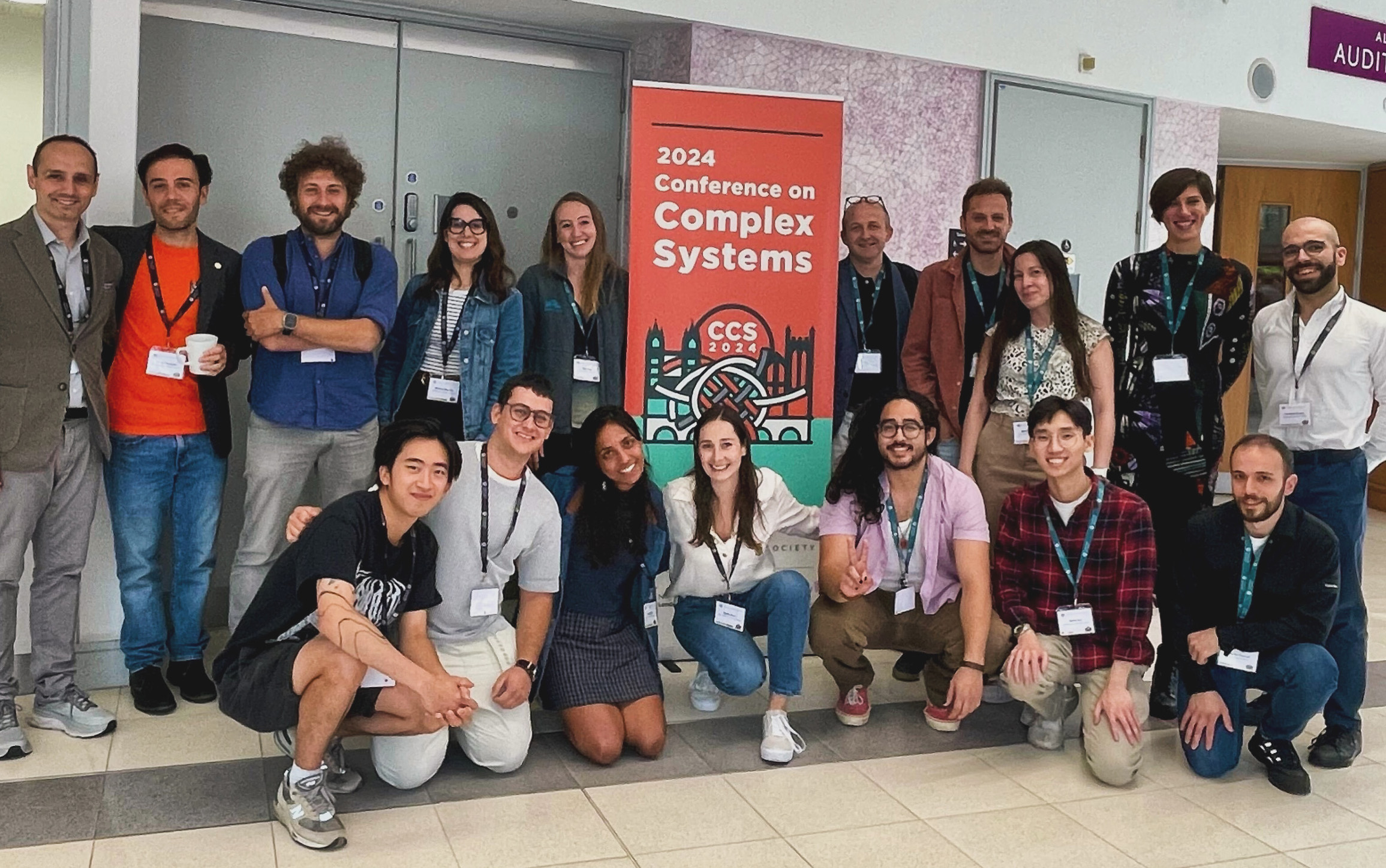
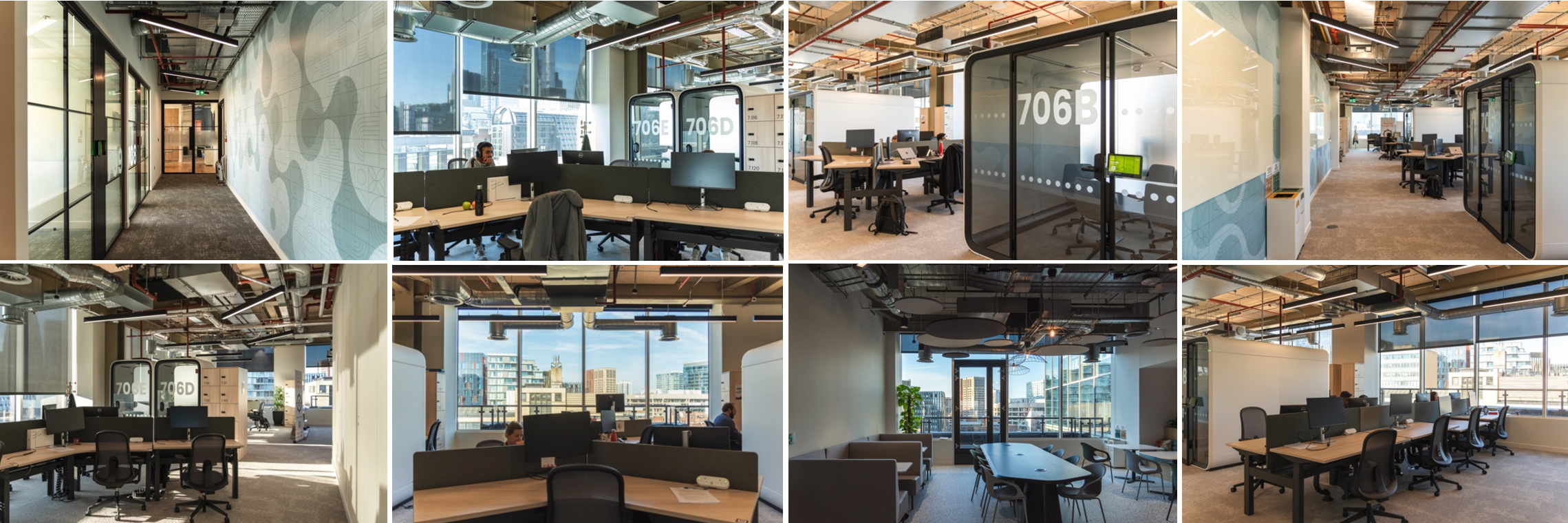
As the Network Science Institute in London settles into its remarkable new home at One Portsoken—a state-of-the-art 72,000 square-foot facility at the edge of London's financial district— the team’s vision to establish the London campus as a launchpad for ambitious scientific initiatives continues to take shape in an ideal environment, through bold ideas, collaborations across Northeastern’s global network, international partnerships, and the pursuit of teaching excellence. With this expansion effectively doubling NUL's footprint, NetSI London now operates from a space purpose-built for knowledge exchange and research. Large classrooms, dedicated study points, and conference rooms with advanced audio-visual technology provide researchers, students, and visiting scholars with all the tools needed for productive collaboration. This timing couldn't be better, as NetSI London has been experiencing significant growth, recently launching the SPAN Lab and BRAN Lab to complement its existing research infrastructure.
A powerhouse team tackling global challenges
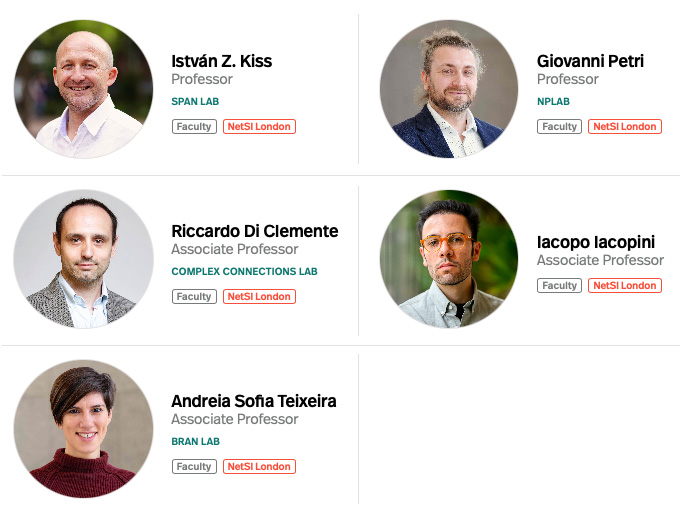
Today NetSI London is a twenty-plus person unit where theory, data, and applications move in lockstep. Five faculty labs and research groups work as a single system: SPAN Lab (István Kiss) builds rigorous models of contagion and diffusion; NPLab (Giovanni Petri) extends those models with higher-order structure to capture group-level dependencies; BRAN Lab (Andreia Sofia Teixeira) tests how social and technological environments, including AI systems, shape cognition and public-health outcomes; Iacopo Iacopini’s group explains how interaction patterns drive discovery and collective behavior; and Complex Connections Lab (Riccardo Di Clemente) mines digital traces to reveal how cities mix, segregate, and change. Insights flow across the teams: city-scale data stress-test spreading models; higher-order methods uncover structure missed by pairwise networks; behavioral and cognitive mechanisms ground what interventions will actually work. At NetSI London, the five labs work as one engine: theory, data, and applications loop together to tackle problems across disciplinary borders.
Building bridges across disciplines and borders
NetSI London's impact extends far beyond its own walls through collaborations that expand the university’s access to real-world data, inform research on current challenges, help formulate new scientific questions, provide complementary expertise, and validate research outcomes.
Work with the UK Health Security Agency brings bedside science into our models: SPAN Lab's statistical methods help optimize decisions for critically ill patients, and the clinical feedback loops sharpen our questions and datasets. City-scale dynamics travel the same loop. Through the collaboration with the ISI Foundation, Prof. Di Clemente co-created the European Mobility Symposium and a shared research stream on segregation and social mixing.
Indeed, methods and applications evolve together. A new workshop with King’s Institute for Human and Synthetic Minds is integrating NPLab’s topological neuroscience into the study of creativity and intelligence, advancing tools that can read structure in both human and machine systems. Those tools leverage rare, global datasets through ReDLat, the Multi-Partner Consortium to Expand Dementia Research in Latin America, where NPLab analyzes brain imaging across socio-economic contexts to investigate how environments shape cognition, knowledge that supports dementia prevention in underserved populations.
Additional bridges widen our access to data and opportunities, such as Dr. Teixeira’s Visiting Academic role at Kent and Medway Medical School that opens clinical collaborations and UK funding avenues in network-enabled health research. Across these collaborative efforts, the pattern is the same: making NetSI London’s impact larger than the sum of its labs.
A momentum for scaled-up research
Together, these partnerships are transforming NetSI London into a high-velocity engine where ideas move quickly from concept to validated results, and from prototypes to real-world solutions. This “next level” of growth involves designing shared research platforms that support multiple projects and cross-campus programs. From London, the Institute convenes collaborators across Boston, Portland, and EU partners to tackle problems that demand scale: human–AI ecosystems, resilient health systems, networked mobility, and the socio-technical infrastructures that connect them.
Momentum is already visible. The award of the European Research Council (ERC) Consolidator Grant to Prof. Petri and his team, with nearly €2 million supporting the project "Reconstruction and Unification of Neural and Ecological Systems" (RUNES), exemplifies the Institute’s frontier work, advancing a new paradigm in network science that focuses on the role of higher-order interactions in shaping complex systems.
Teaching excellence accreditations, such as the Advance HE Fellowships earned by Professors Iacopini, Di Clemente, and Kiss, reinforce a culture that blends scholarship, mentorship, and skills transfer. Building on this foundation, the NetSI London team is bringing the Master’s program in Complex Network Analysis to the London campus, ensuring that the talent pipeline grows in step with the Institute’s research ambitions.
Collectively, these efforts reinforce the position of Northeastern University London as a hub for pioneering, interdisciplinary research within the UK and beyond.


